
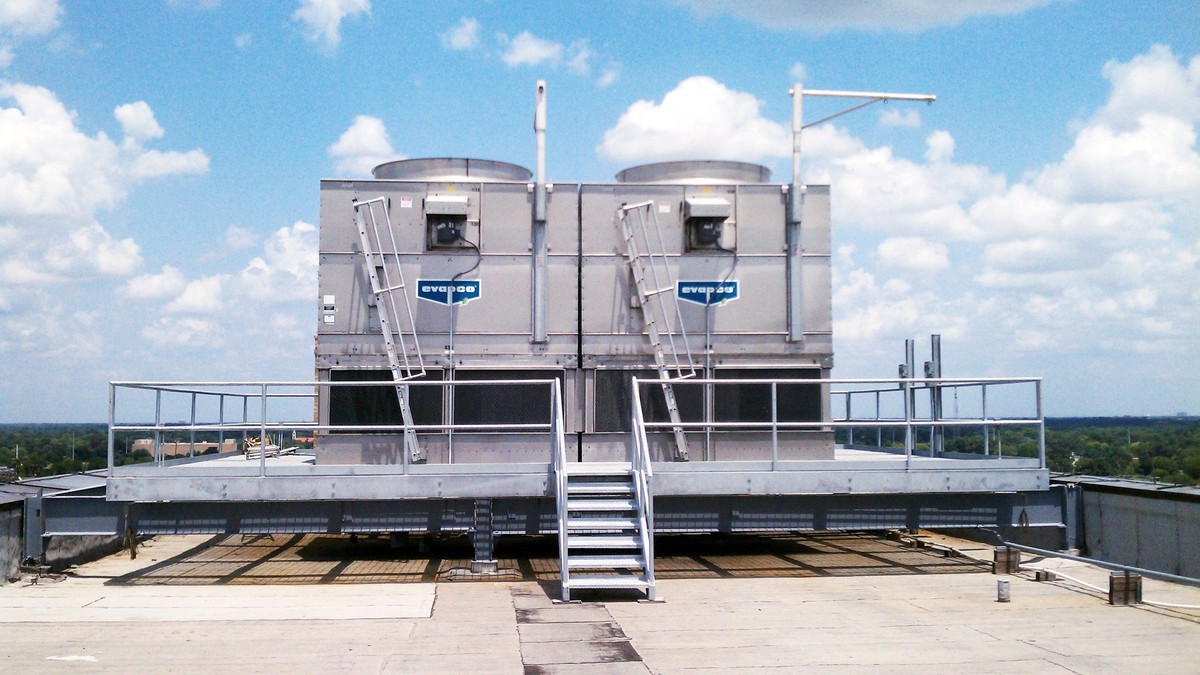
Cooling towers work as lungs in an air conditioning chiller plant. Ambient air comes in contact with condenser water at cooling tower fills. Impurities in air collect at the bottom and circulate in the system. These may deposit on chiller condenser tubes or inside pipe lines when unattended. Constant vigilance and precautionary measures are required to improve plant performance and increase cooling tower and plant life. Overall energy consumption by the chiller depends on cooling tower performance. When cooling tower performs well and provides condenser water to chiller as required, chiller energy consumption is low. A badly performing tower increases condenser water temperature to the chiller, which increases the chiller energy consumption for same output.
Cooling Tower hot water basin has multiple inlets. Water from chiller is distributed on top of fills. When water distribution is not balanced in each inlet pipe, cooling tower can not deliver 100% performance. Balancing valves are provided in each line. Water coming from main line is equally distributed in each branch. Fills on all sides are fully loaded. Without this balancing, one side will get more water than the other and water temperature can not be brought down as required.
Debris and scale deposit on hot water distribution nozzles. All nozzles are required to be clean and providing equal flow. Damaged or clogged nozzles give uneven flow, which keeps some areas of the fills dry. Sunlight propagates growth of algae in hot water basin. This algae circulates everywhere in the system. Hot water basin is covered during operation or in idle conditions. Direct daylight is avoided. This reduces algae growth. Air intake side of the towers is one of the reasons for badly performing towers. Most of the time, architects consider cooling towers as ugly and noisy equipment in a building. They provide space at a location where there are solid walls around. Solid walls restrict air flow. When towers are places close to a wall, this is louvered. Free flows of air around towers provide rated duty. Manufacturers provide data about safe distance of the towers from solid or louvered wall.
For water saving, cycle of concentration (COC) is increased. With increased cycle of concentration, say from 3 to 4, blow down rate is low and chemical usage is high. A very delicate balance exists when deciding about COC. Make up water chemistry, water availability and costs of chemicals are all considered for deciding about optimum COC. For more water conservation it may be increased further.
Correct blade angle and material of the fan save operating energy when properly selected. FRP blades are most efficient. Blade angle is optimized for each season. VFD operation of the fans with proper control sequence provide maximum energy saving.
Leave a comment
Trackbacks (0)
( subscribe to comments on this post )
-
Louis Vuitton wallets
June 21st, 2011 – 05:49It is obvious, you were not mistaken louis vuitton purse handbag , I recommend to you to look for a site where there will be many articles on a theme interesting you. I confirm. All above told the truth. Let’s discuss this question. Absolutely with you it agree. I like this idea, I completely with you agree. It is draw?
( REPLY ) -
hotels in shimla
June 24th, 2011 – 03:36everytime i visit your blog i find atleast one post that interests me.your content never ceases to engage me.
( REPLY )


Leave a comment Cancel reply
No trackbacks yet.
« Salient Features of Healthcare AHU
Recent Posts
- OPTIMUM CHILLER PLANT SEQUENCE OF OPERATION
- EFFICIENCY IMPROVEMENT AND OPERATING COST REDUCTION BY BUILDING BMS SYSTEM
- Salient Features of Energy Efficient Homes
- Interesting story idea for your readers
- Coordinated Practices for Green Building Design
- Use of Thermal Images for Indoor Environmental Control
- Absorption Chiller Suppliers
- Improving Efficiency of Existing Data Centers
- Electric Chiller Suppliers
- HVAC ENGINEER
- HVAC ENGINEER
- ENERGY EFFICIENT OPERATION OF COOLING TOWERS
- Salient Features of Healthcare AHU
- Multipurpose Hall Environment Control
- Piping Network Considerations for Air Conditioning System
Categories
- Absorption Chiller Suppliers
- AHU Coils
- Air Conditioning Systems
- Air Distribution
- Air Filtration
- Air Handling Units
- Building Management System
- Chilled Water Plant ΔT
- Chiller Plant Control Sequence
- Chillers
- Combined Cooling Heating & Power Systems
- Cooling Towers
- Cost Effective and Energy Efficient Air Side Economizer Systems
- Data Center Air Conditioning
- Demand Control Ventilation
- Displacement Ventilation Systems
- Ducting System
- ELECTRIC CHILLER SUPPLIERS
- Energy Efficient Pumping
- Energy Recoveries
- Fans For High Performing HVAC
- Green Building Design
- Green Solution
- Hospital HVAC
- How to Control Low Chilled Water delta-T
- HVAC ENGINEERS
- Indoor Air Quality
- Insulations
- Kitchen Ventilation
- Night Time Precooling
- Noise Control
- Optimized Chiller Operation
- Pumping Solutions
- Refrigerant Pipng
- Smoke Management Systems
- Solar Energy Systems
- Thermal Energy Storage for Cooling
- Variable Frequency Drives
- Variable-Flow Pumping Systems
Archives
| M | T | W | T | F | S | S |
|---|---|---|---|---|---|---|
| « Dec | ||||||
| 1 | ||||||
| 2 | 3 | 4 | 5 | 6 | 7 | 8 |
| 9 | 10 | 11 | 12 | 13 | 14 | 15 |
| 16 | 17 | 18 | 19 | 20 | 21 | 22 |
| 23 | 24 | 25 | 26 | 27 | 28 | 29 |
| 30 | ||||||
Recent Comments
- HVAC Evaporators on Selection of Condensers for Air Conditioning Systems
- louvre windows on Air Conditioning Systems for Restaurants
- HAVC Units on How to Achieve Low Humidity Conditions with Minimum Energy Consumption
- dentist on Identifying Objectionable Noise Sources in Air Conditioning Systems
- ideas for window treatments for bay windows on High Performance Strategies for Solar Protection
Meta
- Log in
- Entries RSS
- Comments RSS
- WordPress.org