
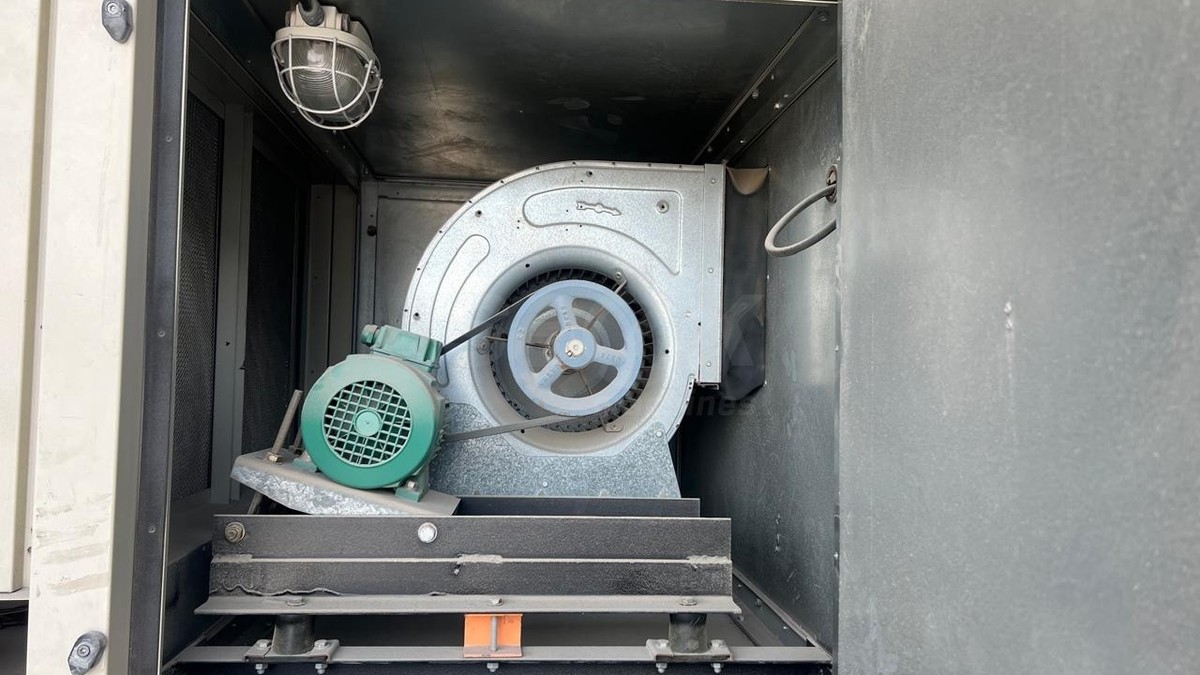
Fan is used in an air conditioning system to move air through ducts and air grilles. It is required to move specific air quantity throughout the system. Amount of air is measured in cubic feet per minute (cfm) or cubic meter per hour (m³/h). This quantity is arrived at after calculating room air conditioning loads. Supply air temperature and room loads are used to select quantity of air which is required to be circulated in order to maintain comfortable conditions inside. Fan cfm is the basic selection criteria.
Resistance to air path is the second parameter for selection of fans. When air moves through equipment, duct and air device, it faces resistance. Air conditioning equipment has number of components. Each of these put some resistance to air flow. This is called internal static pressure. It is the sum of static pressures through mixing box, filters, cooling/ heating coils, eliminators and all other AHU internal components. External static pressure includes losses through supply and returns duct runs, all elbows, dampers and air devices.
Fan selection is based on total static pressure. Total static pressure (TSP) is the sum of external and internal static pressures as described above. CFM of air at calculated TSP is the required work done from a fan. Fan power depends on both these parameters. Higher cfm with large TSP means more power. Motor HP increases with increase in either cfm or TSP.
Combinations of these two parameters determine fan type. For small range forward curved type centrifugal fans are used.
For intermediate range backward inclined type fans are used. For higher cfm and TSP ratings double width air foil types are used.
Noise generation is another important consideration for fan selection. Plenum type fans are quietest of all types. These are fans without housing. They require little space for duct connections and bends. These are especially suitable where there are space limitations. Their price is higher as compared to housed centrifugal fans.
Airfoil type fans have highest efficiencies but their noise level is high. Forward curved fans are quieter but their application range is limited. Fan is selected keeping these variables in mind. Sometimes available space requires duct mounted fans. For this purpose in line type fans are used. They can be suspended from ceiling. Cost of each type of fan varies. Forward curved types are the cheapest while plenum types are the most expensive, followed by airfoil and backward type.
Leave a comment
« Mitigation of Plant Room Noise Transmission
Recent Posts
- Multipurpose Hall Environment Control
- Piping Network Considerations for Air Conditioning System
- Fan Energy Saving Systems for Space Conditioning
- Air Handling Unit Heat Transfer Capacity
- Green Pumping Solutions
- Using Ceiling Space for Return Air Path
- Managing Night Time and Holiday Loads
- Considerations for Services Openings in High Rise Buildings
- Selecting Air Handling Unit Fan
- Mitigation of Plant Room Noise Transmission
- Frictionless Chillers
- Under Floor Air Distribution Systems
- Part Load Performance of Screw Compressors
- Frost Control of Evaporator Coil
- How to Achieve Low Humidity Conditions with Minimum Energy Consumption
Categories
- AHU Coils
- Air Conditioning Systems
- Air Distribution
- Air Filtration
- Air Handling Units
- Building Management System
- Chilled Water Plant ΔT
- Chiller Plant Control Sequence
- Chillers
- Combined Cooling Heating & Power Systems
- Cooling Towers
- Cost Effective and Energy Efficient Air Side Economizer Systems
- Data Center Air Conditioning
- Demand Control Ventilation
- Displacement Ventilation Systems
- Ducting System
- Energy Efficient Pumping
- Energy Recoveries
- Fans For High Performing HVAC
- Green Building Design
- Green Solution
- Hospital HVAC
- How to Control Low Chilled Water delta-T
- Indoor Air Quality
- Insulations
- Kitchen Ventilation
- Night Time Precooling
- Noise Control
- Optimized Chiller Operation
- Pumping Solutions
- Refrigerant Pipng
- Smoke Management Systems
- Solar Energy Systems
- Thermal Energy Storage for Cooling
- Variable Frequency Drives
- Variable-Flow Pumping Systems
Archives
| M | T | W | T | F | S | S |
|---|---|---|---|---|---|---|
| « Feb | ||||||
| 1 | 2 | 3 | 4 | 5 | 6 | |
| 7 | 8 | 9 | 10 | 11 | 12 | 13 |
| 14 | 15 | 16 | 17 | 18 | 19 | 20 |
| 21 | 22 | 23 | 24 | 25 | 26 | 27 |
| 28 | 29 | 30 | 31 | |||
Recent Comments
- admin on Air Conditioning Duct Designing For Minimum Losses
- payday advance loan idaho on Air Handling Unit Heat Transfer Capacity
- Air Pollution Indoors on Air Conditioning Duct Designing For Minimum Losses
- Maxine Catalli on Air Conditioning Duct Designing For Minimum Losses
- Lakendra Krokus on How to Reduce Makeup Air Requirement for Kitchen Ventilation
Meta
- Log in
- Entries RSS
- Comments RSS
- WordPress.org