
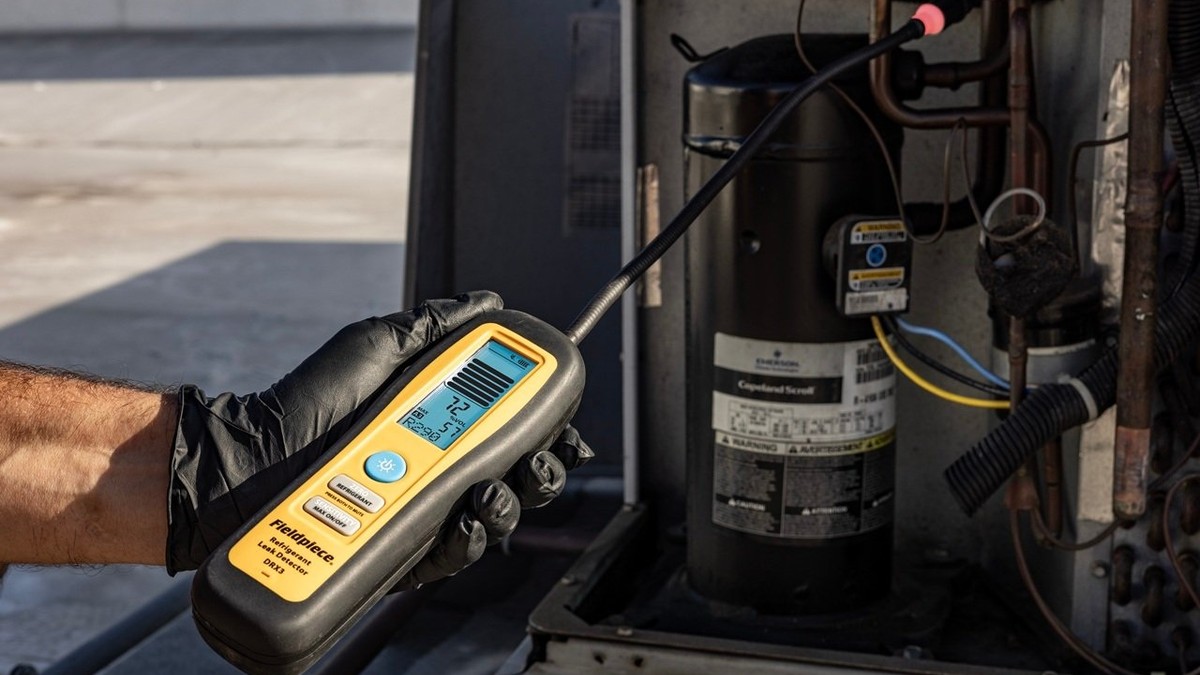
Refrigerant concentration in occupied areas is a health risk. It is injurious to inhabitants when leaks develop in a small space. Furthermore loss of refrigeration capacity and failure of equipment result. In plant room areas refrigerant leaks may cause equipment stoppage in addition to polluting indoor environment.
Electronic refrigerant leak detectors are used in operating systems for leak detection. It is a hand held instrument and very light in weight. It is brought close to each joint, connection and fitting. When there is a leakage, refrigerant vapors react with its element. This action reduces current flow between two electrodes. Signals are generated and picked by this device. It indicates presence of refrigerant by a beeping sound. In plant rooms it may detect refrigerant vapors present. Very minute leakages came be found with this instrument.
Infrared analyzers are used for detection and identifying the refrigerant. This is precision equipment which is very sensitive to refrigerant concentrations. Refrigerant may be mixed with some color or dye. This dye is selected according to equipment type, oil in the system and type of refrigerant. At the point of leakage, this dye appears. UV lamps are used to detect location of leakage. As this light is injurious to human skins, special care is required when using this light.
Refrigerant lines can be evacuated and tested for leakage. Tubes are vacuumed. If vacuum breaks, it means there is some leakage. To locate point of leakage, lines are pressurized with nitrogen or air charge. If possible, small coils are immersed in water. Bubbles appear at point of leakage. When this is not possible on installed system a bubble solution is used. Water mixed with detergent is used. This solution is applied on each joint. Leaking joints show bubbles. In place of soap or detergent liquid oils can be mixed with water. These are applied same way with brush on each joint. Leakage in the system is indicated by appearance of bubbles.
Leave a comment
« Issues with Combustion Exhaust Ducting
Recent Posts
- Multipurpose Hall Environment Control
- Piping Network Considerations for Air Conditioning System
- Fan Energy Saving Systems for Space Conditioning
- Air Handling Unit Heat Transfer Capacity
- Green Pumping Solutions
- Using Ceiling Space for Return Air Path
- Managing Night Time and Holiday Loads
- Considerations for Services Openings in High Rise Buildings
- Selecting Air Handling Unit Fan
- Mitigation of Plant Room Noise Transmission
- Frictionless Chillers
- Under Floor Air Distribution Systems
- Part Load Performance of Screw Compressors
- Frost Control of Evaporator Coil
- How to Achieve Low Humidity Conditions with Minimum Energy Consumption
Categories
- AHU Coils
- Air Conditioning Systems
- Air Distribution
- Air Filtration
- Air Handling Units
- Building Management System
- Chilled Water Plant ΔT
- Chiller Plant Control Sequence
- Chillers
- Combined Cooling Heating & Power Systems
- Cooling Towers
- Cost Effective and Energy Efficient Air Side Economizer Systems
- Data Center Air Conditioning
- Demand Control Ventilation
- Displacement Ventilation Systems
- Ducting System
- Energy Efficient Pumping
- Energy Recoveries
- Fans For High Performing HVAC
- Green Building Design
- Green Solution
- Hospital HVAC
- How to Control Low Chilled Water delta-T
- Indoor Air Quality
- Insulations
- Kitchen Ventilation
- Night Time Precooling
- Noise Control
- Optimized Chiller Operation
- Pumping Solutions
- Refrigerant Pipng
- Smoke Management Systems
- Solar Energy Systems
- Thermal Energy Storage for Cooling
- Variable Frequency Drives
- Variable-Flow Pumping Systems
Archives
| M | T | W | T | F | S | S |
|---|---|---|---|---|---|---|
| « Feb | ||||||
| 1 | 2 | 3 | 4 | 5 | 6 | |
| 7 | 8 | 9 | 10 | 11 | 12 | 13 |
| 14 | 15 | 16 | 17 | 18 | 19 | 20 |
| 21 | 22 | 23 | 24 | 25 | 26 | 27 |
| 28 | 29 | 30 | 31 | |||
Recent Comments
- admin on Air Conditioning Duct Designing For Minimum Losses
- payday advance loan idaho on Air Handling Unit Heat Transfer Capacity
- Air Pollution Indoors on Air Conditioning Duct Designing For Minimum Losses
- Maxine Catalli on Air Conditioning Duct Designing For Minimum Losses
- Lakendra Krokus on How to Reduce Makeup Air Requirement for Kitchen Ventilation
Meta
- Log in
- Entries RSS
- Comments RSS
- WordPress.org